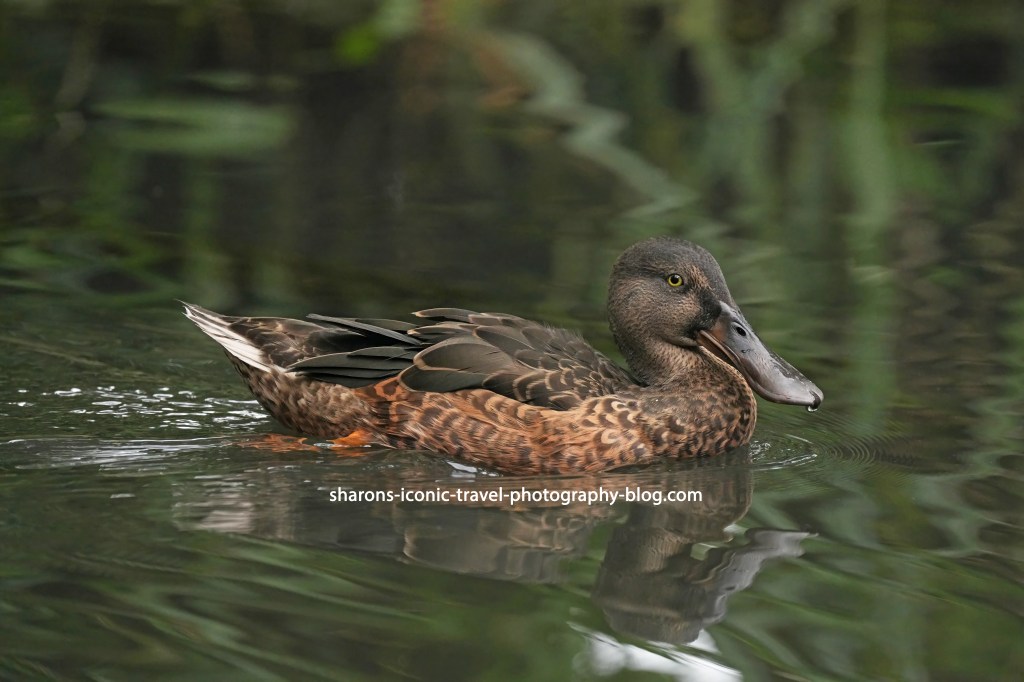
I just came back from a little less than 2 weeks in England. I took lots of photos. It was my first visit since before Covid. I took it slow so I did not travel far and wide daily. I believe this bird is a northern shoveler. If I am wrong, let me know.
Northern Shoveler
I saw this bird close to the Thames River in London. I saw a lot of water birds in London through visits to the Royal Parks etc. This bird was in a pond near the Thames River on a cloudy day, and it was a forested area around the pond, so it was dark. This photo has been lightened.
The northern shoveler is a dabbling duck. Dabbling ducks feed on aquatic plants and small invertebrates on or near the surface or the water.
Some birds I am convinced are ADHD. The tree swallow is constantly on the move, and I find it hard to capture it in photos. It very much seems ADHD.
Tree Swallow on a Birdhouse. – Singing
I was hoping it would land on the birdhouse. Lucky for me, it was reading my mind. It was only there for a short time, but I was able to take a few shots.
Tree Swallow on a Birdhouse – Giving me a look
It stared me down for a bit before it flew off. Do any other birds or animals seem ADHD to you? Have a great rest of your week.
I went to check on the Osprey family this weekend. Parents were flying in and out of the nest, which is a good sign the baby or babies hatched.
Busy Osprey Family
I was hoping to see a parent bring in a fish, but not this time.
Busy Osprey Family – Baby head pops up
I only got a few pictures that included a baby osprey. This is one of them. I do not know if this is the only one.
Busy Osprey Family – Feeding the young fish
I do not think the parent was feeding herself here. They seemed to be handing off low to a baby in the nest.
Busy Osprey Family – Reinforcing the nest
I did not witness a fish being brought in, but saw one of the parents bring in a stick, Considering there is visible in this picture a big hole in this nest, it is probably a good idea. Were you busy this weekend? I hope you had time to relax.
Watch the Eyes! The Osprey seems to be thinking as its mate is flying in. These landings look risky to me.
Watch the Eyes! – Osprey
This nest either has little babies or eggs that have not hatched yet. In the time I was there the mate only flew out to chase perceived threats. No fish were brought in.
Watch the Eyes! – Osprey
I wonder if an osprey ever injuries its mate when flying back into the nest.
Watch the Eyes! – Osprey. The couple is keeping a watchful eye around it.Watch the Eyes! – Osprey. Most likely flying to chase off a possible threat.
Although they seem to have babies later than owls and eagles, it is still that time of year for new life. Pause to reflect on those who gave the ultimate sacrifice that we may be free.
I heard a big chunks falling off a tree to the ground. It was a pileated woodpecker destroying a tree. He was in search of bugs to eat and was tearing chunks of bark off the tree.
They may be starting to nest. There is a lot more activity in the woods. Get out and enjoy a walk in the woods. Unplug from your devices and enjoy nature’s sounds. Enjoy the rest of your weekend!
What do you think of when you hear the term “gray ghost?” For some it brings to mind the football player, Tony Canadeo, who played for the Green Bay Packers many years ago and earned his place in the Hall of Fame. Some people think automatically of of Bruce Wayne’s hero in Batman. Others think of Confederate soldier Mosby who led raids on Federal supply lines during the US Civil War and was known for his ability to appear, disappear, and blend in with locals. But did you know there is a hawk that is known as the gray ghost? The male northern harrier has that nickname.
The Gray Ghost
Males have different colouring than females. All the pictures shown here are male northern harriers.
The Gray Ghost It flys just above and among the tops of the tall grasses.
Diet
Northern harriers eat small rodents such as mice and voles. The location of these pictures appears to have many mice and voles. Amongst other things they eat small rabbits and other birds. They say many farmers like northern harriers because they eat mice that damage crops. Harriers are sometimes called “good hawks” because they pose no threat to poultry as some hawks do.
The Gray Ghost – The one above has blood on its claws from the last catch.
How they Hunt
Northern harriers hunt by flying low to the ground in open areas during the daytime. I frequently see them flying in the late afternoon before the owls come up. When hunting, harriers circle an area several times listening and looking for prey. They can hover and make sharp turns. When they spot prey, they swoop down and grab the prey with their sharp claws. They will also steal prey from owls, which I have seen them try to do at the location pictured.
The Gray Ghost
Native American Symbolism
According to Texas Parks and Wildlife some Native American tribes believe that seeing a hawk on your wedding day is a sign of a long, happy marriage.
This bird has been ghost like and elusive to me. This is the first year I have seen it up close enough to get good shots. Maybe it was tired of the attention the owls were getting. Have a great rest of your week.
The meadowlark is said to be in my area all year long. It is the first time I have captured one on camera. I was on a low level as compared to it. I have heard meadowlarks calling before in grass land areas, but fail to spot one. This one landed on the railing of a viewing platform.
Meadowlark
Have a great week! Here’s hoping you have some sunny days!
Would the American Coot still be here on Christmas? Yes, it was. Before heading out Christmas morning I stopped by the river to feed some ducks and the lone American Coot was still there.
More American Coot – Following the Ducks
This time it fuly came out of the water to where the corn was. He was actually one of the first to come up on land. I actually got a better view of the coot’s legs than during the summer. They are still greenish and very lizard looking.
More American Coot- Heading towards the corn.
He has come close to shore many times, but this is the first time I have seen him go after the corn I leave out. I am guessing this means there is less for it to eat in the water. I am surprised this bird is hanging around.
I hope you had a Merry Christmas and have a healthy New Year!
When I first saw this, I thought this hummingbird was spitting out water. Turns out it is sticking its tongue out. This is only a problem when they can not retract it. I took several pictures in a row and I believe this is the only one with its tongue out.
Thanks to a friend who has hummingbird plants and feeders and her very gracious invitation, I was able to photograph multiple birds visiting her plants and feeders. She finds this time of the year is the best time to see them. The best times to view is between 2-5 p.m. She usually sees them frequently in August after they babies fledge.
It is amazing what you can catch coming to a feeder! Enjoy the rest of your weekend.



 Sharon's Iconic Travel Photography Blog